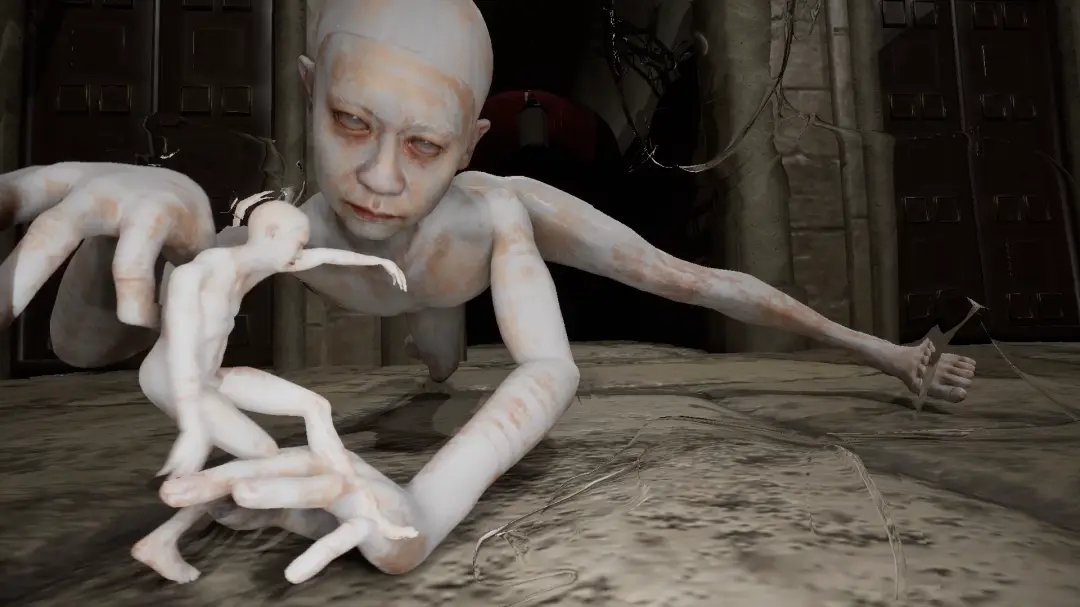
Li Yi-Fan, Screen Melancholy (conceptual image for reference only). © Li Yi-Fan. Courtesy of the artist.
November 4, 2025 –Taipei Fine Arts Museum (TFAM), organizer of the Taiwan’s representative exhibition 2026 at the 61st Venice Biennale, announced that representative artist Li Yi-Fan and the TFAM team have invited Raphael Fonseca, currently the Curator of Modern and Contemporary Latin American Art at the Denver Art Museum (DAM) in the United States, to serve as the curator of the Taiwan exhibition 2026 in Venice.
As a curator of the new generation from Brazil who is active in the international art scene, Fonseca will engage with the artist Li Yi-Fan, a member of the same generation, in a dialogue that spans regions and cultures. The exhibition will respond to the contemporary predicament of information and image overload, ponder the intricate connections and dialectics between humanity and technology, present how Taiwanese contemporary art resonates within the global digital milieu, and explore how individuals relying on their own strength can participate in, understand, and construct the world they inhabit.
Raphael Fonseca holds a PhD in Art History and Criticism from Rio de Janeiro State University (UERJ). He has gained considerable international recognition for his recent curations in Latin America, Europe, and Asia. Fonseca was included in the ArtReview Power 100 list of the world’s most influential contemporary art figures for two consecutive years (2023, 2024). He was the chief curator for the 14th Mercosul Biennial in 2025, where he first collaborated with Li Yi-Fan and where they established their foundation for dialogue.
Fonseca is known for constructing exhibition venues with a humorous, absurd curatorial vocabulary, viewing exhibitions as gatherings and stages that incorporate familiar popular culture elements to provoke visitors to reflect on contemporary issues—an approach that mirrors the dark humor and dramatic narratives found in Li Yi-Fan’s work.
Fonseca has long focused on the creative practices of artists from the Global South, exploring the cultural and political energy present in cross-regional contemporary art. He considers how the juxtaposition of different contexts can stimulate viewers to reflect on contemporary issues, and he excels at expanding the possibilities for international conversations through an open and diverse vision.
TFAM director Li-Chen Loh notes, “With the curator’s rich international experience and unique perspective, we look forward to seeing the Taiwan exhibition 2026 delve a pathway of contemporary engagement that will seize the attention of the new generation. Viewing things from the perspective of the South, it will spark a shared deliberation of images, technology, and human existence.”
Theme Announced: Screen Melancholy
Taipei Fine Arts Museum has also revealed the title for next year’s Taiwan exhibition: Screen Melancholy. This phrase centers on a motif found frequently in art history—“melancholy”—as a response to the anxiety and gloom that arise with the flattening of perception when people face a world constrained and molded by today’s digital environment. The exhibition will continue Li Yi-Fan’s long-standing exploration of image-generation technology and improvisational narrative, using his unique creative approach to challenge our habitual modes of viewing and perception. In an age of information overload and constant flux, he not only engages in technological innovation, but also raises questions about perception, subjective consciousness, and how humankind will express itself in the future. Life is short, but knowledge is boundless. When we cannot fully grasp everything through reason or archival science, perhaps “melancholy” is all that remains as a means to respond to our present experiences.
Currently an artist-in-residence at the Rijksakademie in the Netherlands, Li Yi-Fan has made several visits to the Palazzo delle Prigioni in Venice, informed by these international experiences, he envisions creating a labyrinthine, virtual/real-world environment that connects with the architecture of the Palazzo itself. It will feature a site-specific video work in the Palazzo’s central hall, complemented by several larger-than-life sculptures of human body parts arranged at different angles and scattered throughout various rooms and corridors, with the aim of provoking reflection on material fragmentation. As viewers are surrounded simultaneously by images, sounds and sculptures, a bodily environment of “both watching and being watched” will take shape. The overall space will function as a fluid stage, where the movement of the viewer becomes a form of participation in the narrative. The constantly shifting scenes and the rapid speech of the characters in the video reflect the anxiety and weightlessness present in the current era’s torrent of information.
Fonseca notes: “Li Yi-Fan is always exploring the relationship between artists and media (or software tools), tracing its evolution from painting, cinema and animation all the way to today’s AI-generated images. This reveals his obsession with contemporary image production. Then, through humorous, absurd techniques, he critically responds to the evolution of image-generation tools and the formation of image politics. With his upcoming group of works, he aims to incite sensory experiences and change the way people understand the no world.”
A Death Match between Artist and Software
The exhibition at the 61st Venice Biennale 2026 will feature a one-piece video installation. In this work, Li performs a monologue in his signature “educational channel” style. He examines the operational model of “Software as a Service” used by contemporary image production tools, the influence of “specific media” on how humans perceive the world, how such model change the user's understanding of the nature of image representation, and ultimately, the current topic that cannot be ignored: AI-generated images. This allows the medium itself to become a vehicle of perpetual reflection, interpretation, and transformation.
“I think of my creative process as a ‘death match between the artist and software,’” says Li Yi-Fan. “Within the counterbalance of exhaustion, tension and collision, a narrative slowly emerges. In contemporary image production, artists inevitably rely on lots of different software tools. Some are open-source and free, while others are highly commercial. Each choice represents a different possibility for expression, but also has its own limitations and controls. I move among these systems, trying to grasp the subtle relationship of dependence and resistance between artists and contemporary tools. Through this process, using these image production techniques, I contemplate the state of humankind in relation to technological media.”
Since 2019, Li Yi-Fan has been developing his own image-making tools using real-time game engines, live videos and dynamic modeling systems. In this way he contemplates the strange suspension of time and space in video games and explores the relationship between technological mediation and narrative construction. In important_message.mp4 (2019-2020), for example, he experimented with the real-time 3D creation tool Unreal Engine for the first time. And in Rewiring (2020), he recorded human body movements with motion capture to explore how humans in the digital age control their virtual bodies, delving into the erotic fantasies that arise from control technology.
Li has long centered his attention on the intermingling and overflow of information in the world of the internet and the disturbance it causes to the body and mind, constructing leaping narrative techniques and oratorical scripts. For example, his work howdoyouturnthison (2021) skillfully manipulates a wriggling avatar of the artist that murmurs from a first-person perspective, discussing conspiracy theories about people and technology. Meanwhile, What Is Your Favorite Primitive (2023) takes the form of a satirical tech keynote presentation, ruminating on how images reshape communication and speculating whether image technologies might one day project an as-yet-unrealized totality—constructing a new politics of life and death.
For a long time, Li Yi-Fan has employed a method similar to digital puppetry—creating narratives in oral tones reminiscent of various online tutorials. In so doing, he not only questions himself, but also challenges viewers to consider the diverse aspects of human knowledge, conveying a pessimistic mood about the present and the future. As the video scenes change, so do the theatrical backdrops. Layers of information accumulate, forming an encyclopedic viewing experience. This expresses humanity’s vast desire to control the world and our insatiable curiosity, while also highlighting the limitations of our understanding—ultimately returning to a core question: What exactly does it mean to be “human”?
About the Artist, Li Yi-Fan
Li Yi-Fan currently lives and works in Taipei, Taiwan. He often explores the relationship between people and technology in the digital age with a unique sense of black humor. He excels at using self-developed game engines and, working as a one-person crew, improvisationally acting out the narratives that lie in the background behind image production. In recent years, with the support of such projects as the National Culture and Arts Foundation’s “WSAD” and Taiwan Contemporary Culture Lab’s “Toolkit of Madness,” Li has conducted studies on machinima and developed a series of game-engine-based image production toolkits to create artworks such as important_message_360.mp4, rewiring, howdoyouturnthison, and What Is Your Favorite Primitive. He has also been featured in the 2020 Taiwan Biennial “Subzoology,” the 2020 Digital Art Festival Taipei “01_LOVE,” the 2021 Asian Art Biennial “Phantasmapolis,” and the 2023 Taipei Biennial “Small World.”
About the Curator, Raphael Fonseca
Raphael Fonseca was born in Rio de Janeiro, Brazil, and lives in Denver, United States. He is a curator and head of the Department of Modern and Contemporary Latin American Art at the Denver Art Museum, where he has worked since 2021. He holds a PhD in Art History and Criticism from UERJ the State University of Rio de Janeiro, Brazil. He is the chief curator of the 14th Mercosul Biennial, which happened in 2025. In 2023 and 2024, ArtReview magazine included him among the 100 most influential people in the visual arts globally.
Among his projects, highlights include "Fullgás: Visual Arts and the 1980s in Brazil" (Centro Cultural Banco do Brasil, RJ, DF, SP, and MG, 2024-2025); "Sandra Vásquez de La Horra: The Awake Volcanoes" (Denver Art Museum, United States, 2024); "Who Tells a Tale Adds a Tail" (Denver Art Museum, USA, 2022); "The Silence of Tired Tongues" (Framer Framed, Amsterdam, Netherlands, 2022); and "Lost and found" (ICA Singapore, 2019).